
Journal
サン・クロレラの取り組みや
サポートするアスリートたちのTOPICS。(PR)
Find out about Sun Chlorella's corporate activities and sponsored athletes
Ran Takahashi
Volleyball player
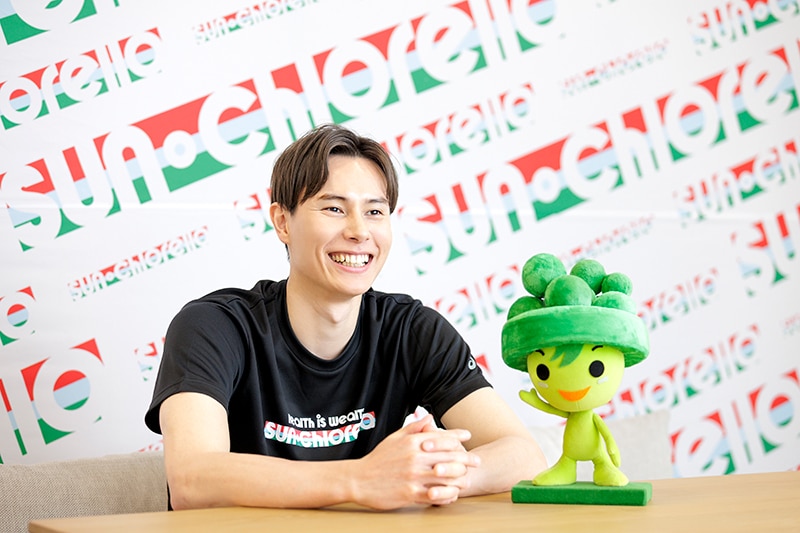
Since earning his first call-up to the Japan national team at just 18, Ran Takahashi has taken on the Italian league as a university student and played a central role for Japan at both the Tokyo and Paris Olympics. Now 24, he has spent this season pushing his body to new limits—seeking a higher level of performance while competing through the grueling, seven-month SV. League campaign.
In pursuit of what he describes as a greater “sense of hang time,” Takahashi has committed to strict nutritional control, intensive training, and listening closely to his body. The result: a physique that matches his ideal. “My performance has definitely improved,” he says with confidence.
In this first part of a two-part interview, Takahashi discusses what led him to transform his body, the specific methods he used, and the critical role nutrition plays for athletes—drawing from his own experience.
Chasing Sharpness by Reducing Weight and Body Fat

The SV. League regular season consists of 44 matches, and including the championship finals, teams play close to 50 matches over roughly seven months, from October to May. It’s an intense schedule that demands both physical and mental toughness.
Yet even as the season enters its defining phase—with back-to-back championships on the line—Takahashi shows no signs of fatigue. If anything, he looks stronger than ever.
“This season, I’ve been very disciplined with my diet and conditioning. I can really feel the results, and I know I can still improve even more. Compared to before, I feel much better overall.”
This season marked a deliberate “body transformation” for Takahashi. While he has always been conscious of his physical condition, he placed particular emphasis on reducing body fat to unlock higher performance.
The turning point came during national team training last season.
“During the training camp in Satsumasendai, I felt like I lacked sharpness. Especially in my jumps—I couldn’t feel that floating sensation. Then we went straight into the Nations League, and I couldn’t quite find my rhythm.
When I spoke with my trainer about how to improve, he suggested that lowering my weight and body fat while increasing muscle strength would help. So I decided to go for it. With advice from a nutritionist, I started managing my diet more carefully to find my optimal body composition.”
A Simple Diet – Built Around the Steamer

At the time, Takahashi weighed around 83–84 kg with a body fat percentage in the high 12% range—numbers that might already seem ideal for a volleyball player. However, during a long season, maintaining weight can be just as challenging as gaining it.
“I tend to lose weight easily during the season, so until now, I focused more on eating enough to maintain my body rather than the quality of what I ate.”
This time, however, he took a different approach. Without compromising nutritional quality, he made intentional changes to reduce both weight and body fat.
“I was already consuming a lot of carbohydrates and protein, but I hadn’t paid much attention to quality. I used to eat all kinds of meat—chicken, pork, beef, even fatty cuts. After changing my diet, I mostly switched to chicken breast and fish.
I learned that fish provides high-quality protein, so I reduced carbohydrates and focused more on better protein sources. Even with carbs, I became more aware—fruits contain sugars too, so I adjusted accordingly. I cut down on rice and noodles and increased beans instead. It was very detailed.”
Strict dietary control can be stressful—but for Takahashi, one tool made it surprisingly manageable: a steamer.
“I got really into steaming food. I’d put in chicken breast or tenderloin along with various vegetables and just steam everything. It’s simple, you get a wide variety of nutrients, and most importantly—it tastes great. And it’s healthy.
I don’t have picky eating habits, so I tried all kinds of combinations. Honestly, I’d recommend it to anyone, not just athletes (laughs).”
Healthy, delicious, and effective—his approach to eating may inspire more than just performance gains.
How His Physical Transformation Changed the Game—Starting with His Serve

Takahashi’s disciplined approach has clearly paid off. His weight has dropped to 79–80 kg, and his body fat percentage to around 9.3–9.5%. More importantly, he has regained that crucial “hang time.”
“I can clearly feel that I’m jumping better. I stay in the air longer, which allows me to read the block and choose where to hit. The power, speed, and impact are all different. I can also feel that my explosive strength has improved.”
The numbers back it up. He ranks among the league leaders in both spike success rate and serve effectiveness.
「“With a lighter but stronger body, I can jump higher and achieve that ‘floating’ feeling. The view during attacks has completely changed.”
Longer hang time allows him to strike before the block is set—or even adjust mid-air after reading it.
“My body feels sharper overall, and my swing has gotten faster. The sensation at the moment of contact is completely different. I think the stats reflect that too.”
Among all aspects of his game, Takahashi believes his serve has improved the most
“My serve has more sharpness and consistency. I can be aggressive when I need to, and even my short serves are effective. I can confidently say now that serving is one of my weapons.”
Interestingly, one key factor behind his improved serve performance is teammate Tomohiro Ogawa, the libero for both club and national team.
He also lets me know if the opposite hitter is in reception. In one recent match, even Kentaro Miyaura was in receive, so I went after him and got an ace (laughs).”
Just as Ogawa supports him on the court, Takahashi credits another key partner off the court: Sun Chlorella.
Throughout his body transformation, he carefully selected foods and cooking methods—but also ensured he didn’t miss essential nutrients.
“I’d mix Sun Chlorella powder into yogurt for breakfast, lunch, and dinner. Sometimes I’d add honey or try different variations—it’s enjoyable, and it makes it easy to get the nutrients I need.
As a professional athlete, I’m always grateful for the support I receive. Sun Chlorella has been with me since my student days, before I had achieved anything. It’s truly something I appreciate.
This season, as I worked to reduce body fat and improve performance, it was an essential part of my routine.”